
A Trouble Code Is Not a Diagnosis: What Your Check Engine Light Is Really Telling You

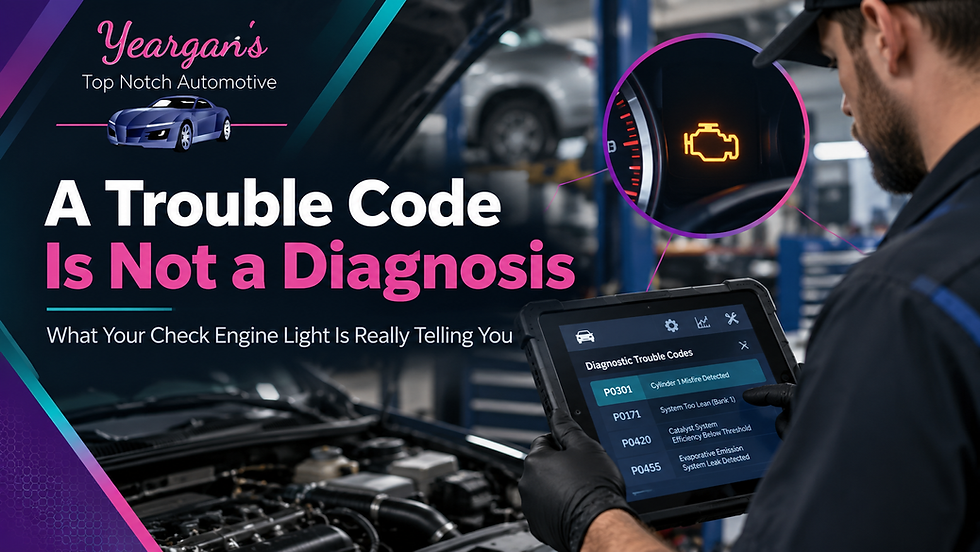
When your check engine light comes on, one of the first things many drivers do is have the vehicle scanned for a trouble code. Sometimes that happens at an auto parts store, sometimes with a handheld scanner at home, and sometimes at a repair shop.
The scanner may return a code that mentions an oxygen sensor, an emissions system, a misfire, a fuel mixture problem, or another system in the vehicle.
That information is useful, but it is not the same thing as a diagnosis.
What a Trouble Code Actually Tells Us
Modern vehicles continuously monitor dozens of systems. When the computer detects something outside of its expected range, it stores a Diagnostic Trouble Code, or DTC.
That code gives a technician a starting point.
For example, a code may indicate that the engine is running too lean. That does not automatically mean one specific part has failed. The actual cause could be a vacuum leak, a fuel delivery problem, an airflow sensor issue, an exhaust leak, a wiring problem, or something else entirely.
The code tells us where to begin looking. It does not necessarily tell us what part to replace.
Why Replacing the “Part in the Code” Can Get Expensive
One of the most common mistakes in automotive repair is replacing parts based only on a trouble code.
A scanner might display wording that includes the name of a sensor or system, which can make it seem as though the solution is obvious. But if that component is only reporting a problem caused somewhere else, replacing it may not fix anything.
Then another part gets replaced.
And perhaps another.
Before long, a relatively straightforward diagnostic problem has turned into an expensive guessing game.
Proper diagnosis is designed to avoid that.
What Happens During a Professional Diagnosis?
Once we retrieve the trouble codes, the real diagnostic work begins.
Depending on the problem, a technician may need to:
Review live data from the vehicle's computer
Test electrical circuits and wiring
Measure voltage, resistance, or current
Check fuel pressure or other system pressures
Perform a smoke test for leaks
Inspect components and connections
Compare sensor readings
Road test the vehicle
Reproduce the exact conditions that caused the problem
Sometimes the answer is found quickly. Other times, especially with intermittent electrical problems or symptoms that only occur under certain conditions, diagnosis takes more time.
That time is not spent simply reading a code. It is spent determining why the code was set in the first place.
The Same Code Can Have Different Causes
Two vehicles can arrive with the exact same trouble code and need completely different repairs.
Vehicle A may have a failed component.
Vehicle B may have damaged wiring.
Vehicle C may have a vacuum leak.
Vehicle D may have another problem causing the system to operate outside its normal range.
That is why experienced technicians follow diagnostic procedures instead of assuming the code itself provides the answer.
What About Free Code Scans?
There is nothing wrong with having a code scanned. It can provide useful information and help you understand which system has detected a problem.
The important thing is knowing what that information means.
A free scan is generally a code retrieval service. A professional diagnosis goes much further by testing the vehicle and determining the actual cause of the problem.
Those are two very different things.
Why Proper Diagnosis Can Save You Money
Paying for diagnostic time can sometimes feel frustrating, especially when you are already facing a repair bill.
But accurate diagnosis can prevent unnecessary parts from being replaced and help ensure that the repair actually addresses the problem.
The goal is not to replace the most likely part.
The goal is to identify the cause, repair it correctly, and get the vehicle back on the road with confidence.
When Your Check Engine Light Comes On
If the light is on steadily and the vehicle seems to be operating normally, schedule an appointment to have it evaluated.
If the check engine light is flashing, the vehicle is running poorly, or you notice severe shaking, loss of power, overheating, or other serious symptoms, continuing to drive may cause additional damage.
At Yeargan's Top Notch Automotive, we believe good repairs start with good information. Trouble codes are an important part of that process, but they are only the beginning.
Remember: A code points us in a direction. Diagnosis tells us what is actually wrong.


Comments